Anytime Plug-and-Play Control with Contract-Based Distributed MPC
ETH Zürich & EPFL
ETH Zürich & EPFL
Abstract
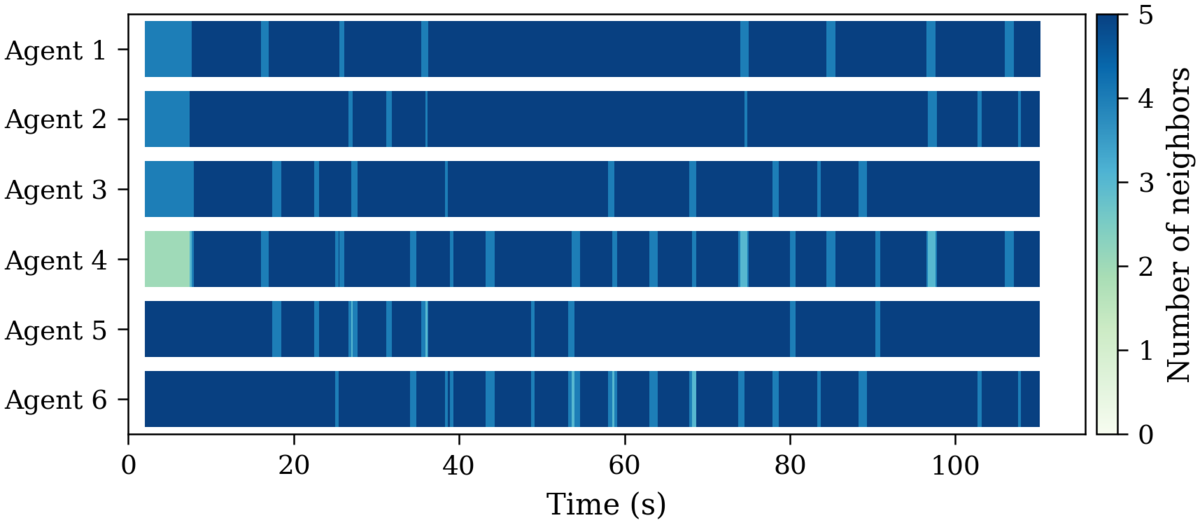
A central challenge in many mobile multi-robot applications is that communication topologies are inherently time-varying. Agents may enter or exit the network and such changes cannot generally be restricted a priori. This work introduces a distributed multi-agent control algorithm based on local communication that supports anytime agent joining and leaving the communication network without centralized coordination.
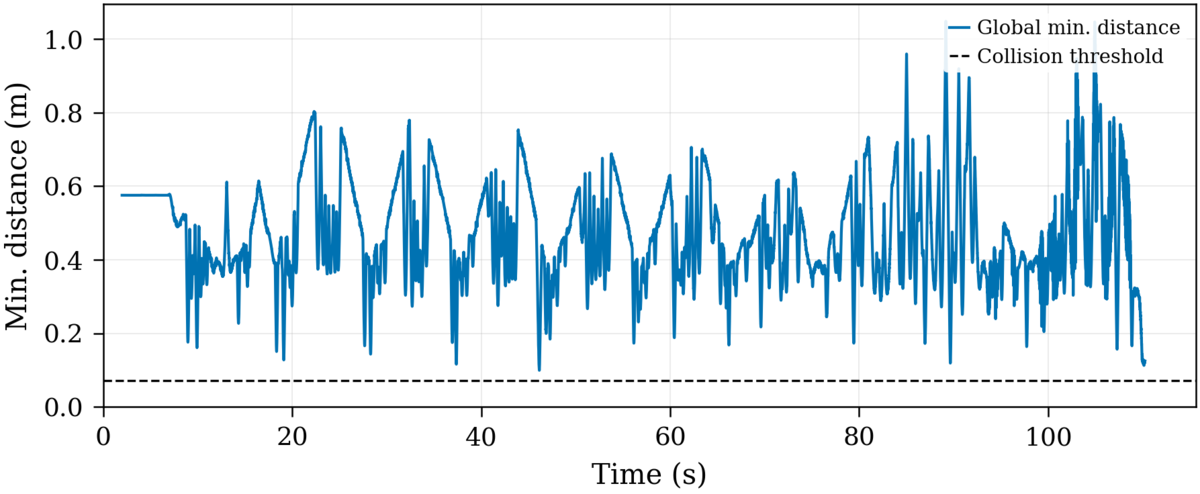
The method scales efficiently with the number of agents by relying on a distance-based neighbor definition and on contracts derived from predicted trajectories. The resulting contract constraints guarantee collision avoidance and constraint satisfaction. We validate the proposed method in an autonomous multi-agent driving scenario, demonstrating effective collision avoidance in high-speed, dynamic environments with agents moving in opposite directions, in both simulated and real-world experiments.
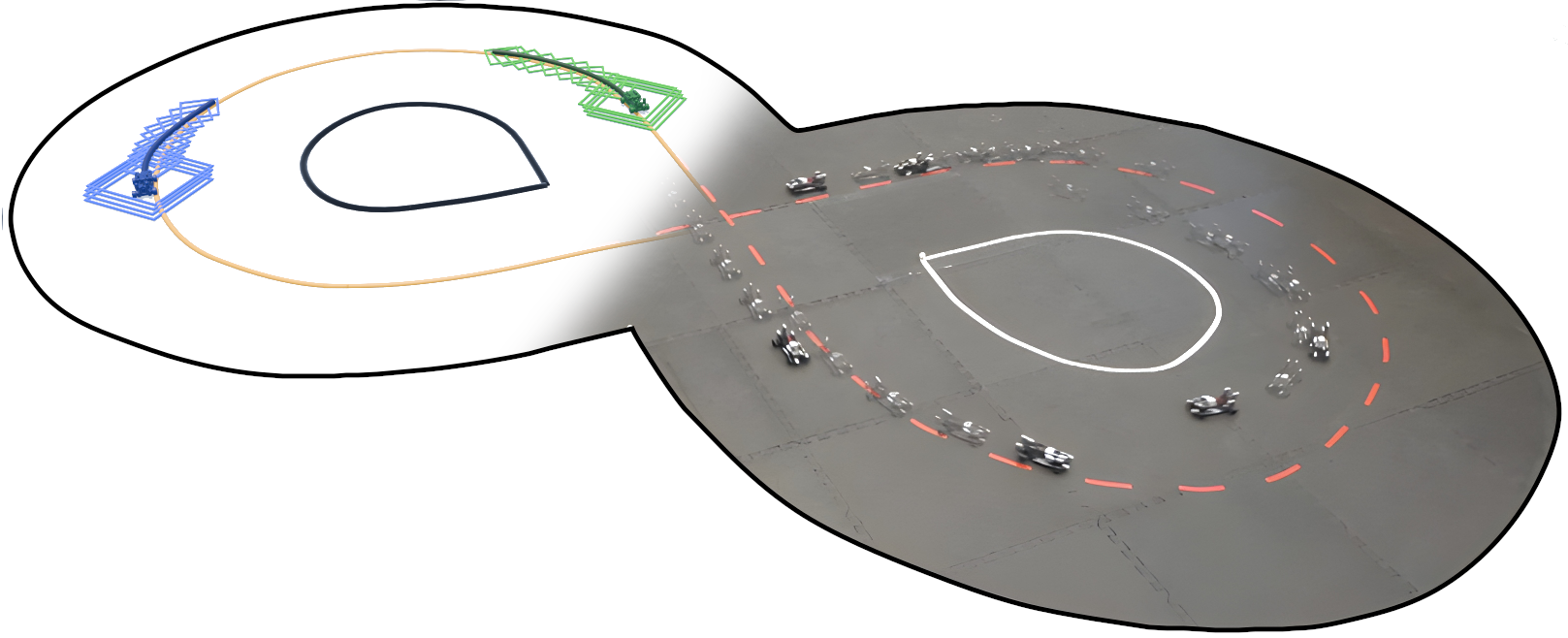
Simulation: 8 agents on a figure-eight track
Hardware: Real race cars navigating safely
Supplementary Video
Overview of the Anytime Plug-and-Play framework, including method explanation, simulation results with up to 8 agents, and hardware experiments on miniature race cars.
Method
We replace coupled collision-avoidance constraints with local contracts that can be constructed from a single exchange of predicted trajectories with current neighbors.
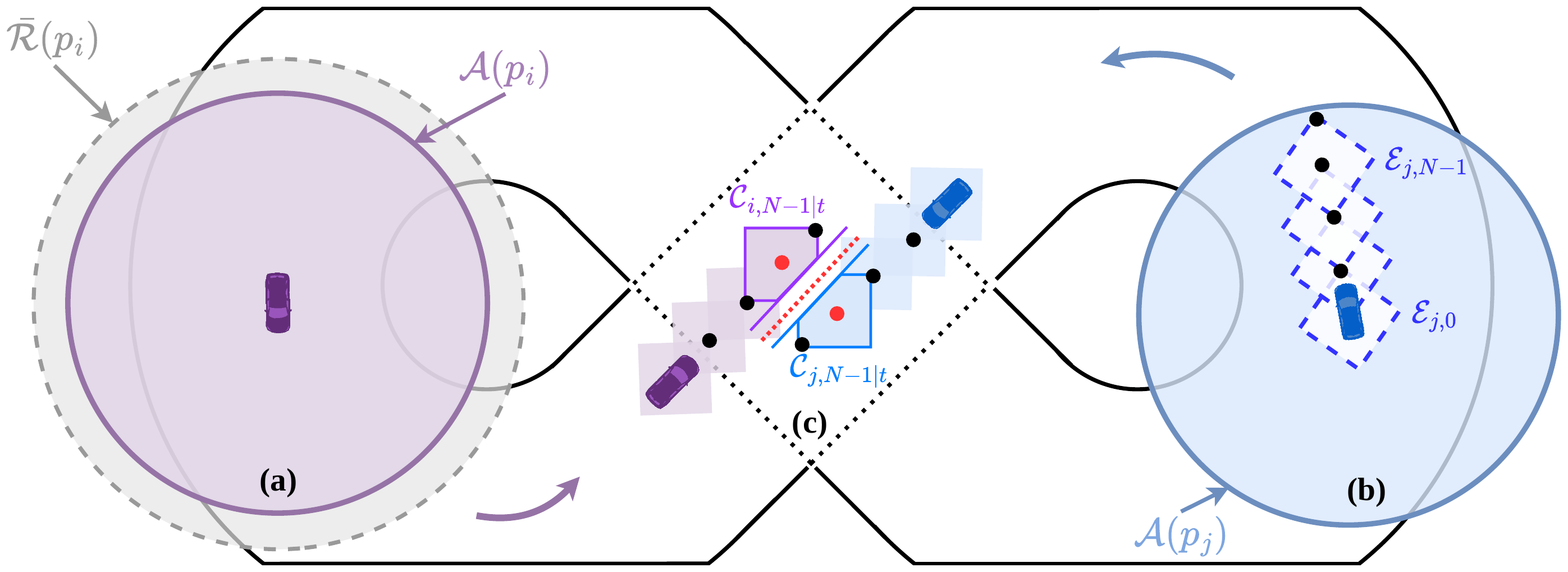
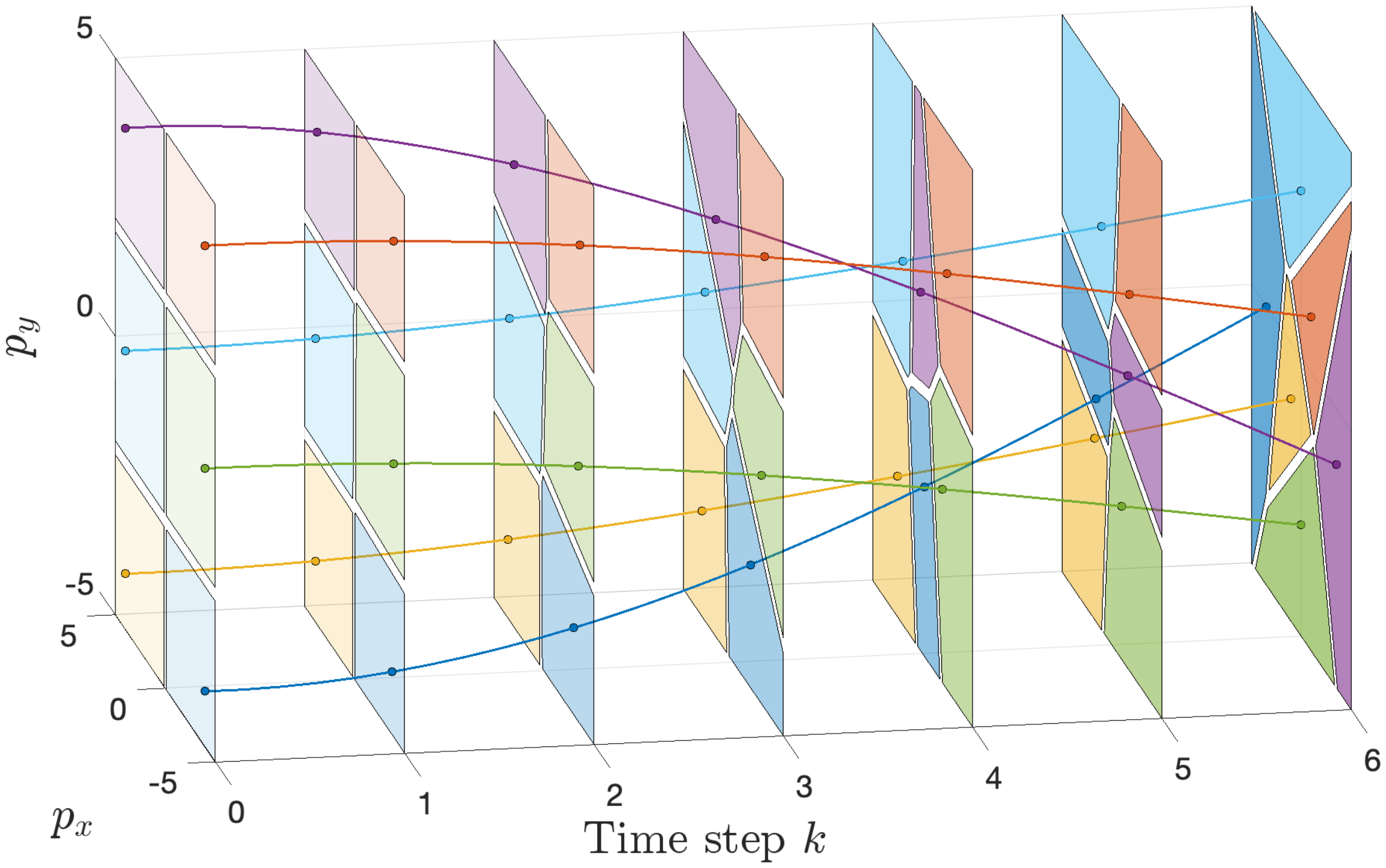
Stage-wise convex regions computed from predicted trajectories exchanged with neighbors. They locally separate agent trajectories to ensure collision-free paths between neighbors via Voronoi-type partitioning.
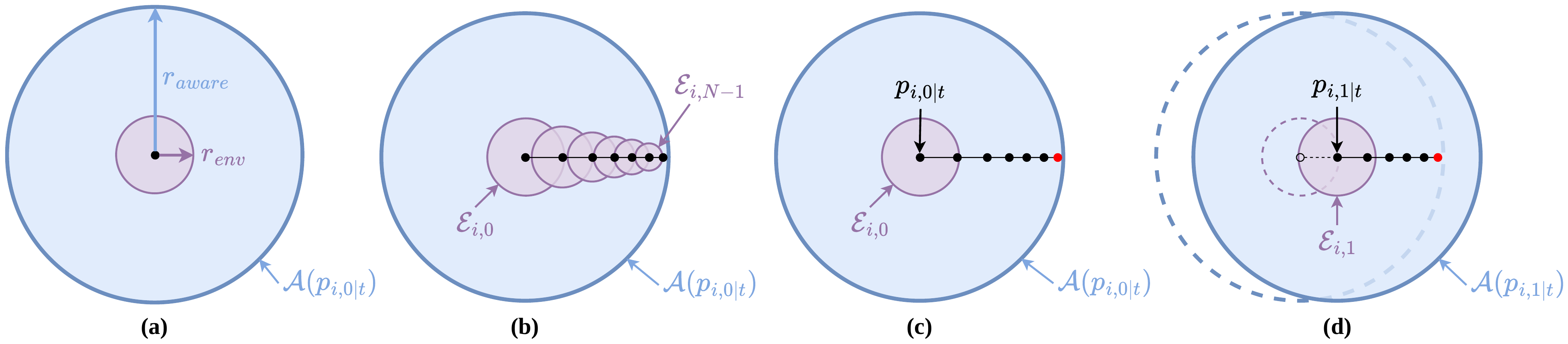
Scaled-down copies of the awareness set that constrain successive position increments. Their cumulative effect guarantees the predicted trajectory stays inside the awareness set, preserving recursive feasibility.
Each agent solves a local optimization problem using only neighbor-to-neighbor communication. The contract (cells + safety envelopes) decouples collision avoidance, enabling fully distributed execution.
Experiments
We validate the approach in simulation (up to 8 agents) and hardware experiments (up to 6 cars) on a figure-eight track, featuring overtaking, intersection crossing, and oncoming traffic.
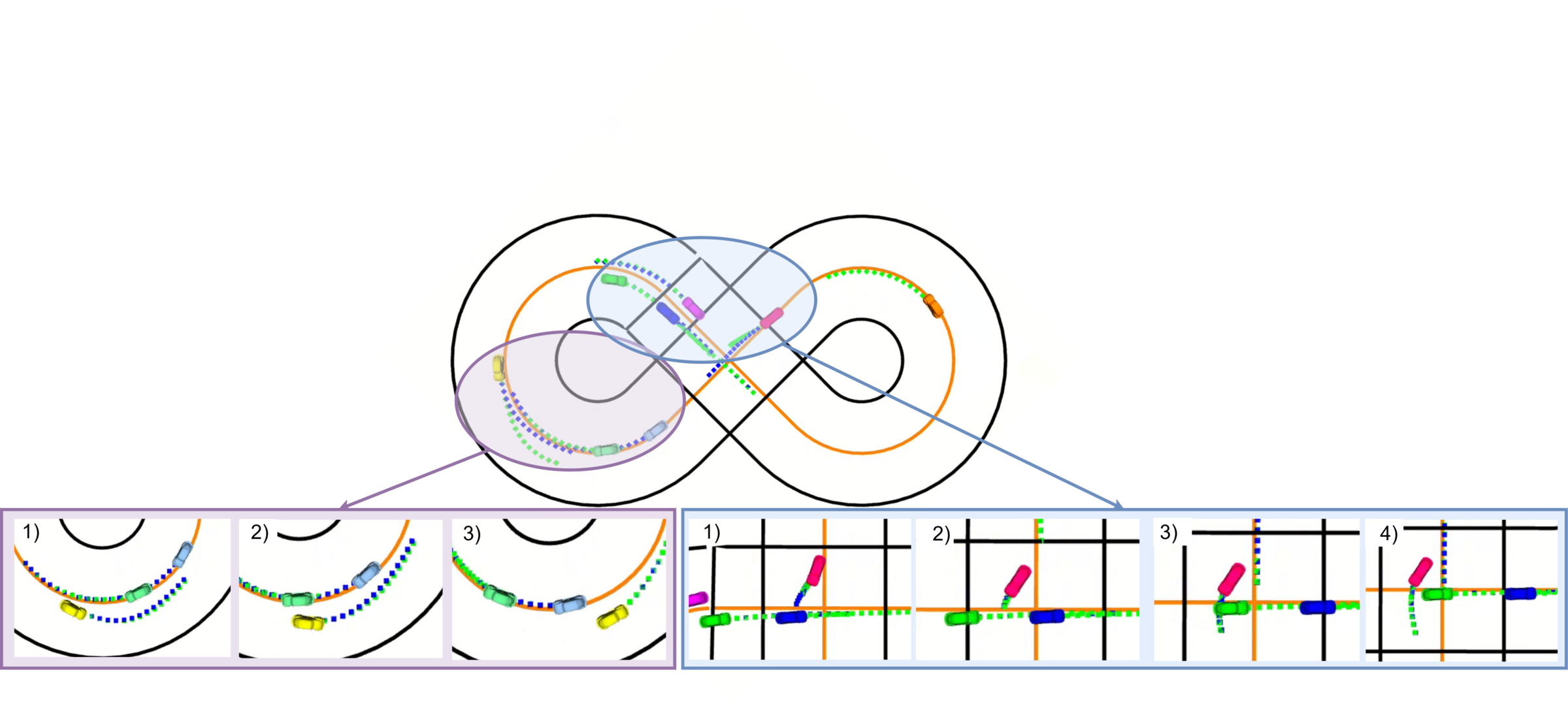
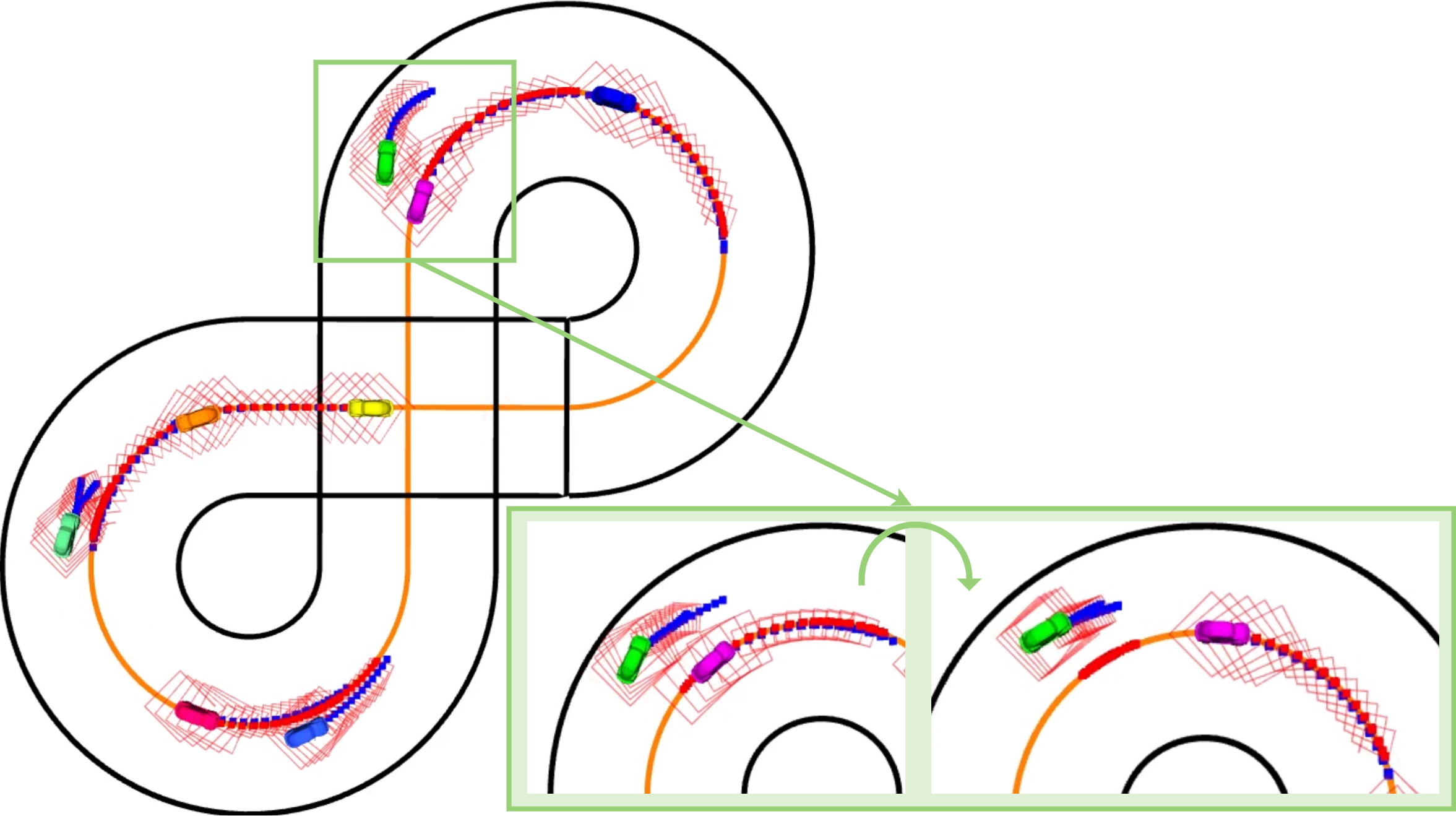
The faster purple agent overtakes the slower green agent on the inner rim of the curve, enabled by curvature-dependent hyperplane angling. Red boxes show safety envelopes constraining position increments.
Multiple agents simultaneously approach the figure-eight intersection. Each agent navigates safely through the congested area without collisions, using only local neighbor communication.
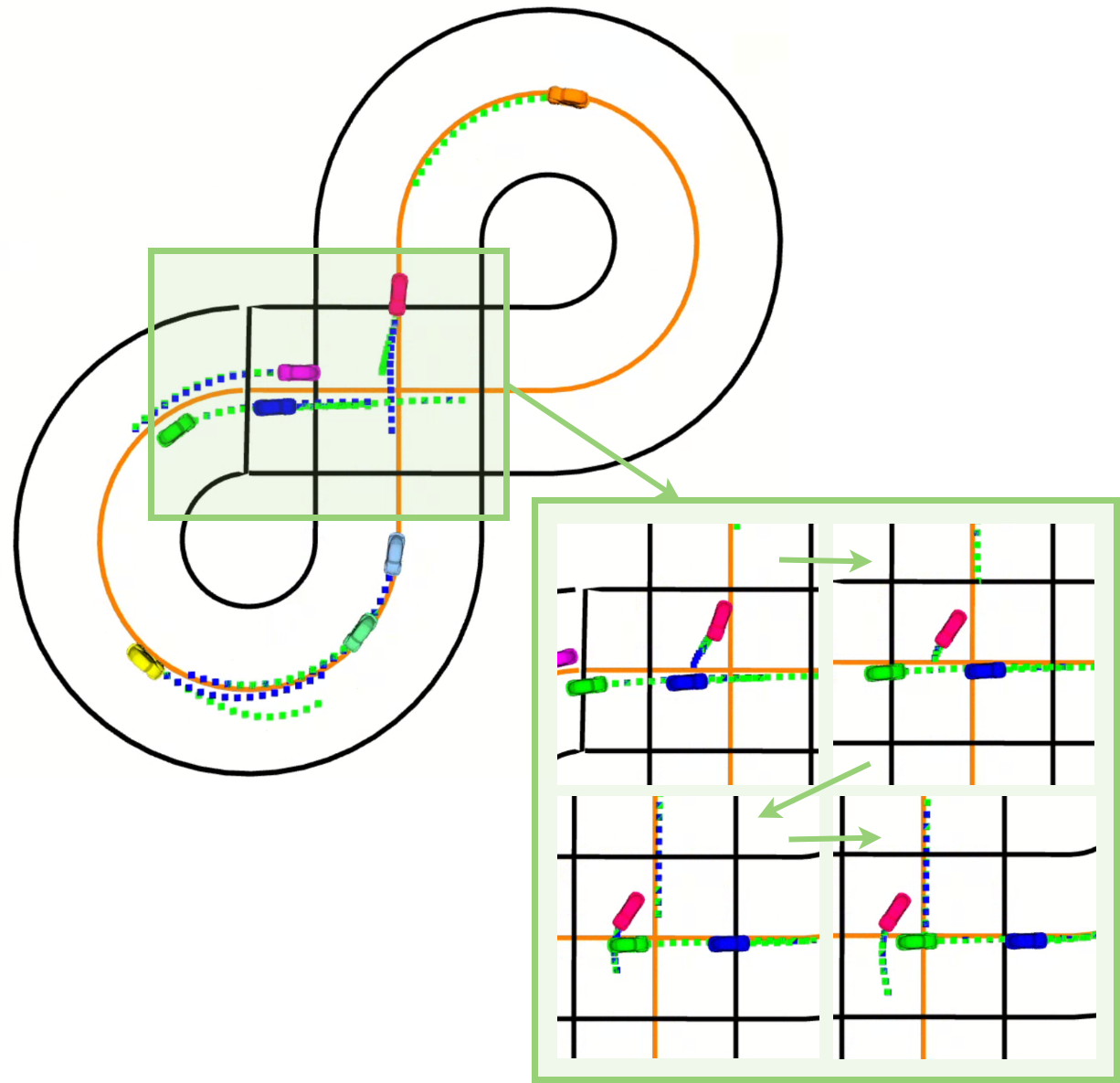
Agents traveling in opposite directions must avoid each other. The safety envelopes and cells adapt in real time as the communication topology changes with each encounter.
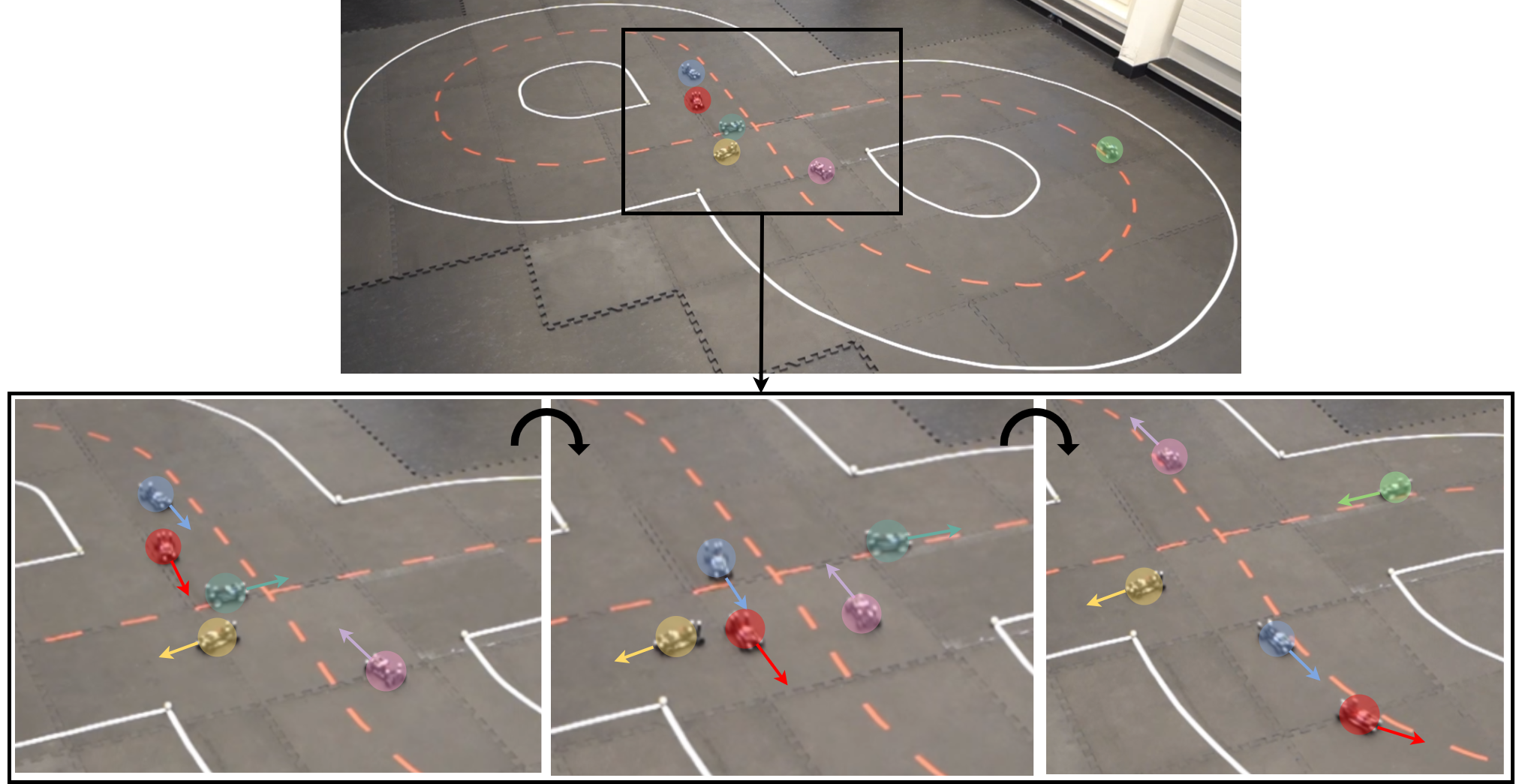
Miniature race cars navigating the figure-eight track in real time, demonstrating collision-free operation under anytime plug-and-play conditions.
Results
Our method is the first to achieve all desirable properties: distributed, nonlinear, anytime plug-and-play, with formal safety guarantees, and non-iterative/non-sequential execution.
| Approach | Distributed | Nonlinear | Plug-and-Play | Safety Guarantees | Non-cooperative | Non-Iterative | Non-Sequential | |
|---|---|---|---|---|---|---|---|---|
| Global Coord. | Priority-based | ✓ | ✓ | × | × | ✓ | × | × |
| Leader-Follower | ✓ | ✓ | × | × | × | ✓ | × | |
| Distributed SQP | partially | ✓ | × | ✓ | ✓ | ✓ | ✓ | |
| Constraint-based | Safety Tube | ✓ | × | × | × | ✓ | ✓ | ✓ |
| Consistency Constraint | ✓ | ✓ | × | ✓ | ✓ | ✓ | ✓ | |
| Contract Constraint | ✓ | ✓ | request-based | ✓ | ✓ | ✓ | ✓ | |
| ECBF | ✓ | ✓ | × | ✓ | ✓ | ✓ | ✓ | |
| CBF-induced QP | ✓ | ✓ | × | ✓ | ✓ | ✓ | ✓ | |
| Anytime PnP (ours) | ✓ | ✓ | anytime | ✓ | ✓ | ✓ | ✓ | |
| Traffic App. | Assisting Take-Over | ✓ | × | request-based | × | × | ✓ | × |
| Bidirectional Mixed-Traffic | ✓ | × | anytime | × | × | ✓ | × | |
| Highway Merging | × | ✓ | n/a | × | × | ✓ | ✓ |
Bold = our method. ✓ = property satisfied, × = not satisfied. Categories from Scattolini (2009).
Citation
@article{bodmer2026anytime,
  title     = {Anytime Plug-and-Play Control with Contract-Based Distributed MPC},
  author    = {Bodmer, Sabrina and Saccani, Danilo and Zeilinger, Melanie N. and Carron, Andrea},
  journal   = {arXiv preprint},
  year      = {2026},
  note      = {To appear}
}